




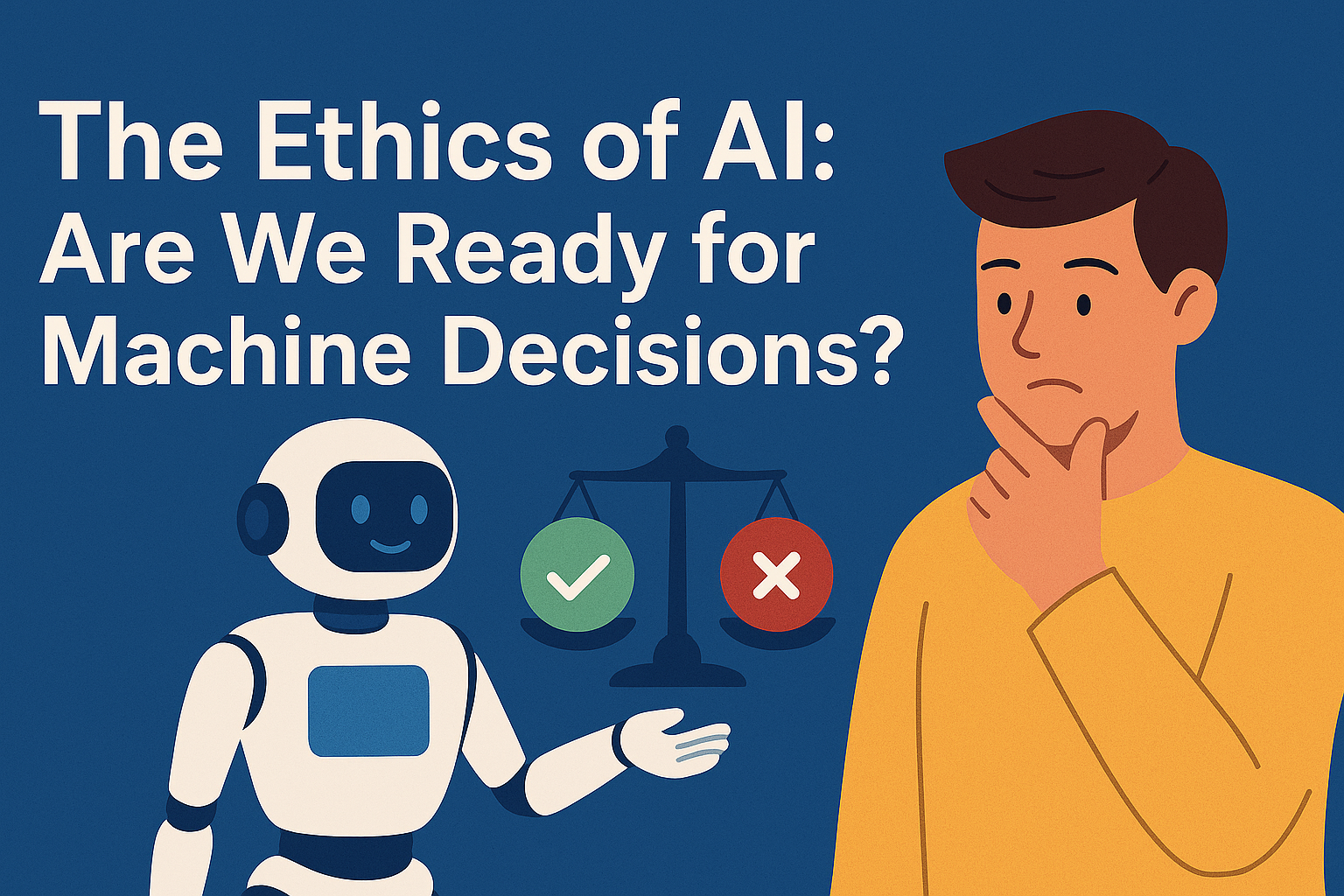
Artificial Intelligence (AI) is not just a futuristic idea; it is already influencing education, healthcare, banking, and even law enforcement. Concerns regarding Ethics of AI, accountability, and moral responsibility are becoming increasingly important as a result of this quick integration. We must consider whether we are ready to establish unambiguous ethical standards for AI as it starts to make decisions that impact human lives. This article examines whether society is prepared to accept decisions made by machines, the ethical concerns surrounding AI, and the difficulties associated with machine autonomy.
What Do We Mean by AI Ethics?
The principles and rules that dictate how artificial intelligence should be developed, implemented, and utilised responsibly are referred to as Ethics of AI. AI is capable of learning, adapting, and making decisions on its own, unlike conventional software. This poses important queries:
- Should AI adhere to human moral principles?
- When AI makes a bad decision, who is responsible?
- Are machines able to comprehend morality in the same way that people do?
AI ethics is a social, legal, and philosophical matter in addition to a technical one. It compels us to reconsider how humans and machines interact, particularly in light of ethical limits on artificial intelligence.
Why Are Ethical Issues in AI So Important Today?
Sensitive fields like financial decision-making, AI in Healthcare diagnostics, and criminal justice are seeing an increase in the use of AI systems. When algorithms make decisions that could change people’s lives without being transparent, reinforce bias, or violate privacy, ethical concerns in AI come up.
For instance:
Minority communities may be disproportionately targeted by predictive policing tools.
AI in healthcare may put financial savings ahead of patient care.
If automated hiring systems are trained on biassed data, they may discriminate on the basis of race or gender.
These difficulties demonstrate that AI judgements are not impartial. Ethical oversight is essential because they reflect the data and values that are ingrained in them.
Can AI Truly Understand Morality?
Whether or not machines can ever understand morality is one of the most contentious issues. Humans base their decisions on cultural values, empathy, and context. AI, on the other hand, operates on probabilities and patterns. It can mimic empathy or fairness, but it lacks these emotions.
Think about self-driving cars: should the vehicle put pedestrian or passenger safety first if an accident is inevitable? This “trolley problem” demonstrates how challenging it is to encode moral boundaries for AI. Even if a machine makes a perfect decision, it cannot defend it using human morality.
Who Should Be Responsible for AI Decisions?
One of the main concerns in Ethics of AI is accountability. Should we hold the company that implemented the AI system, the developers, or the machine itself accountable if it causes harm? Considering how AI is used in daily life highlights the importance of addressing these situations, yet laws are currently ill-prepared to manage them.
- Ethical design and testing must be ensured by developers.
- AI must be used transparently and responsibly by organisations.
- To define liability, governments must establish precise regulations.
Adoption of AI systems in crucial fields will be more difficult if there is no accountability, as trust in these systems will decline.
What Role Do Bias and Fairness Play in Ethical AI?
One of the most important ethical concerns in AI is bias. AI frequently inherits human biases because it learns from past data. Unfair treatment in hiring, lending, law enforcement, and other areas may result from this.
For instance, a hiring algorithm that has been trained on industries with a high male workforce may unjustly turn away female candidates.
For instance, darker-skinned people have been found to have higher error rates in facial recognition systems.
Diverse datasets, open decision-making, and frequent audits are necessary to create fair AI. These actions aid in preventing inequality from being sustained by machine decisions.
How Can We Set Moral Boundaries for AI?
Determining what machines can and cannot decide is the first step in establishing ethical limits for AI. Certain decisions, like those that deal with justice, human dignity, or life and death, should continue to be made by humans.
Among the methods for setting moral limits are:
ethical standards (such as UNESCO’s AI ethics recommendations) for the development of AI.
laws that restrict the use of AI in delicate fields.
human-in-the-loop systems, in which human consent is needed for final decisions.
We run the risk of allowing machines too much influence over human destiny if we don’t set clear boundaries.
Are We Ready for Machine Decisions in Everyday Life?
AI already affects our daily decisions, such as what we watch on Netflix and how credit scores are determined. However, most people are hesitant to fully trust machines when it comes to high-stakes decisions, like medical diagnoses or court sentencing.
The following determines readiness:
Public trust: People require reassurance that AI is safe, transparent, and equitable.
Education: In order for citizens to make wise decisions, they must comprehend how AI operates.
Policy: Before allowing AI to make decisions, governments must put in place robust safeguards.
Society might not be ready to embrace moral decisions made by machines until these conditions are met.
What Is the Future of AI Ethics?
Working together, technologists, legislators, ethicists, and the general public can shape the ethics of AI in the future. Society as a whole must be involved in moral decision-making; we cannot leave it to engineers. Understanding the different types of AI is essential for creating responsible frameworks, and industry-led ethical standards like the EU’s AI Act are positive moves.
Over time, ethical AI will need to be continuously modified. The difficulties posed by AI will change as it does. Making sure that machines support humanity rather than take the place of human judgement is crucial.
Conclusion: Are We Ready for Machine Decisions?
There is no easy solution to the question, “The Ethics of AI: Are We Ready for Machine Decisions?” While AI brings efficiency and innovation, it also raises profound ethical issues in AI, from bias and accountability to fairness and autonomy.
We must set clear ethical guidelines for AI so that decisions that have the potential to change lives are still subject to human review. As we move forward, society’s readiness will depend on strong governance, transparent design, and a collective commitment to responsible innovation.
The goal of AI ethics in the future is to guide AI’s decisions within human values, not to stop it from making decisions. We won’t be fully prepared for machine decisions until then.